
Seminar at Colibri-CRIC, Dschang
On 17 February 2026, I participated in a hybrid Colibri-CRIC conference on impact-driven research and artificial intelligence, in person in Dschang, in my role as Vice-Coordinator of ITASD.
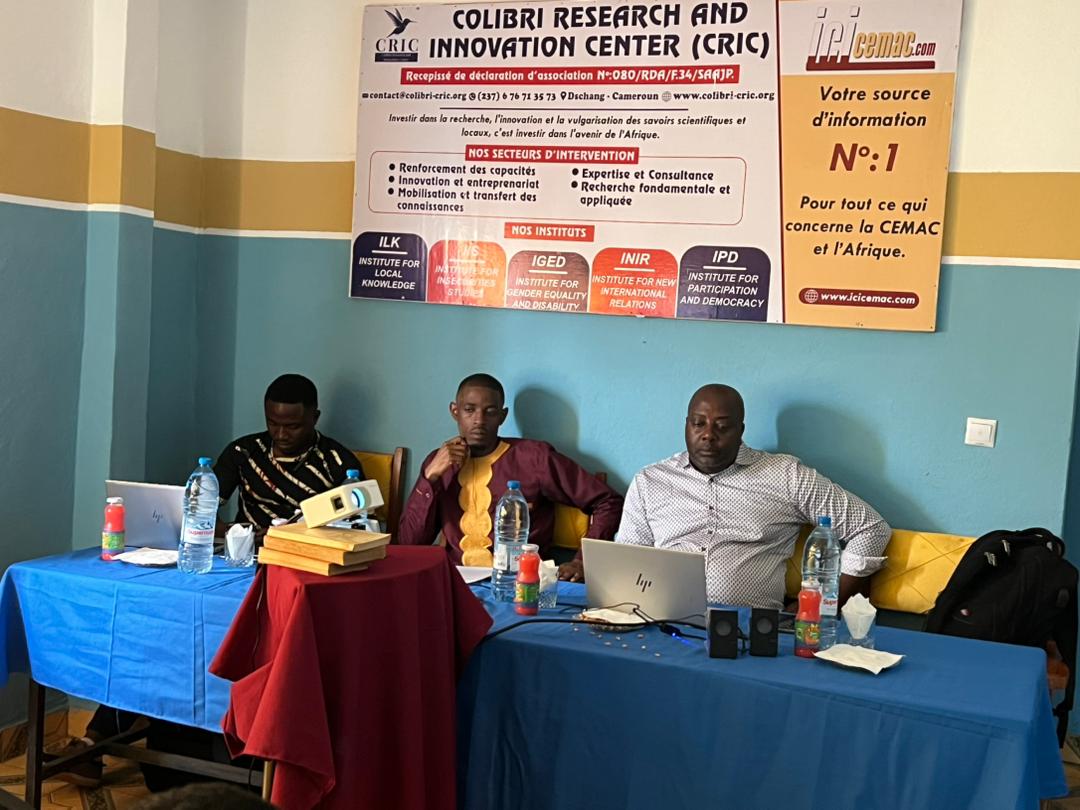
Conference Summary
On Tuesday 17 February 2026, the Colibri Research and Innovation Center (CRIC) organized a special conference on "Faire de la recherche à impact : focus sur l'intelligence artificielle", led by Prof. Samuel Fosso Wamba (TBS Education, France; President of 237 DIASPROF). I attended in person in Dschang as Vice-Coordinator of ITASD.
| Item | Details |
|---|---|
| Date | 17 February 2026 |
| Format | Hybrid (Zoom + in-person) |
| Venue (in-person) | CRIC headquarters, Dschang (Menoua, West Region, Cameroon) |
| Time | 14:30 - 16:30 |
| Speaker | Prof. Samuel Fosso Wamba (Information Systems & Data Science, TBS Education; Vice-Dean for Research) |
| My role | Vice-Coordinator, ITASD |
| Theme | Research impact with a focus on artificial intelligence |
What Happened During the Session
The in-person audience was composed mainly of Master 1 and Master 2 students, doctoral students, and early-career researchers from social and exact sciences. The conference was opened by Dr Boris Metsagho Mekontcho, Executive Director of CRIC, and remained highly interactive with contributions and questions from both in-person and online participants.
- Opening note: the speaker was presented as the first researcher to offer a conference at CRIC on a major issue of our time, artificial intelligence.
- Interactive format: questions from participants were integrated throughout the session.
- Target audience relevance: the discussion was particularly useful for young researchers building their research positioning and methodology.
Key Messages I Retained
- Impact-oriented research is a dynamic cycle: research is not only knowledge accumulation, but a problem - process - solution cycle that should connect with real actors and real needs.
- AI should be understood beyond buzzwords: the talk clarified what AI is, distinguished weak AI and strong AI, and emphasized four capabilities (perceive, understand, act, learn).
- Societal impact remains under-researched: a major point was the imbalance between technical AI research and research on social impact (about 97% technical vs 3% focused on social good).
- AI can support research work: summarization, hypothesis generation, and prototyping can accelerate research, but only with ethics, rigor, critical thinking, and transparency.
- Education and research must adapt intelligently: AI should be treated as a partner for learning and research, not a crutch, with stronger emphasis on critical, creative, and relational competencies.
Implications for Academic Practice
- Assessment redesign: when AI can draft large parts of a text, evaluation should place more weight on oral presentation, coordination, and critical reasoning.
- Publication ethics: the use of AI in research writing should be declared transparently when submitting to journals.
- Applied relevance: impact-driven research should intentionally address underexplored societal priorities (education, inclusion, crisis response, information verification, justice, public-sector management).
About Colibri-CRIC and ITASD
Colibri-CRIC provides a strong environment for research dialogue and innovation-oriented exchange. ITASD (Institute of Technology and Advanced Science for Sustainable Development), within the Colibri-CRIC ecosystem, aligns well with this perspective by connecting science, technology, and sustainable development concerns.
Seminar Photo Highlights
For my portfolio, this conference was an important milestone in strengthening an impact-oriented perspective on research and on the responsible use of AI in academic work. A fuller recap (in French) is available on the Colibri-CRIC website: Retour en images sur la conférence spéciale : « Faire de la recherche à impact : focus sur l'intelligence artificielle » animée par Samuel Fosso Wamba.